Showing posts with label Art History: Modern. Show all posts

Monday, April 3, 2023

Art Gallery NSW: Australian Modern Art — Part 3 Sensuality

Sensuality

Blessed with fertile land, Australians cultivated an abundant life of materialistic pleasure. Such prosperous life greatly influenced Australian modern artists and their works. Many artists regarded that the voluptuous and muscular forms of Australians reflected the rich country's power. Thus, they celebrated the physical beauty of Australians by preserving them in their paintings. In their works, they often related sensuality with procreation and nurture, linking back to the role of fecund Australian land to settlers. To capture the nourished beauty, they incorporated techniques from European classical art and avant-garde.


Charles Meere, Australian beach pattern, 1940, Oil on canvas

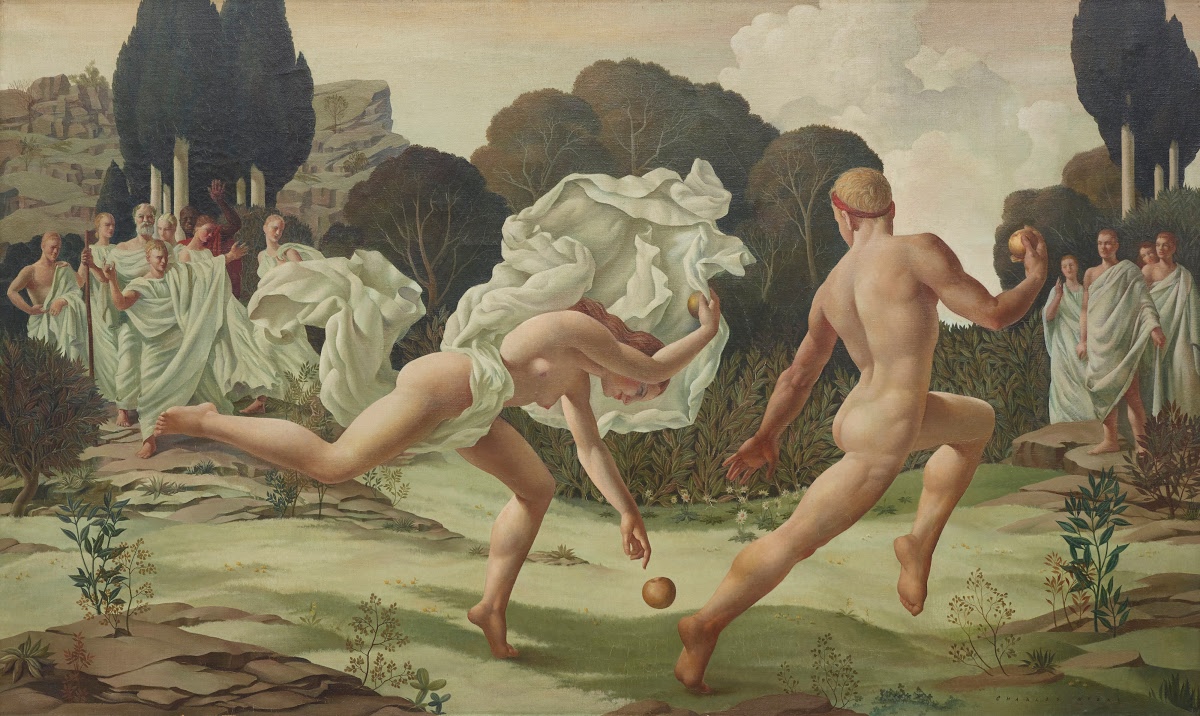
Charles Meere, Atalanta's eclipse, 1938, Oil on canvas
Charles Meere was one of a group of Sydney artists whose work depicted Australian life during the inter-war period and modernized classical artistic traditions. Yet, he painted works of neo-classical style, most notably Atalanta's Eclipse, which shows a running race scene between Atalanta and Melanion. Contrasting to other suitors who competed with the huntress to marry her, Melanion won the race by distracting her with three golden apples.
The artist contributed to cultivating Australian modern art by painting works inspired by the art nouveau of the European avant-garde. One of his art deco masterpieces is Australian Beach Pattern, which was painted during the interwar period. Though full of enigma, the masterpiece is interpreted as a celebration of a healthy young nation's beach culture and a glorification of heroic racial purity.

Jean Broome-Norton, Abundance, 1934, cast 1987, Bronze

In the exceptional art-deco relief 'Abundance', a wholesome and athletic Australian family is presented. By adding the child, the artist relates sensuality to procreation and fecundity of the bodies. Sheaves of wheat and a wreath are rich provisions from the fertile land of Australia. As the family's body is from the food, the artist expresses gratitude towards the bountiful nature. The work reinforces notions of Australian life as a golden age of physical and environmental harmony.

Arthur Murch, The idle hour, 1933,
Oil on canvas on hardboard
The nakedness of the mother suggests she just finished feeding her baby. The mother, along with her baby, radiates sensuality with glossy skin and precariously hanging clothes. Their porcelain-like skin combined with warm key light from the window imbues sublime energy to the setting. The exceptional rendering of light's effect on skin indicates the artist's deliberate study of lighting and masterpieces of the early Renaissance and classical periods.
The artist associates sensuality with the sublime by showing the role of a mother as a nurturer of a family. To create images of national culture, the artist depicts Australian modern life by employing classical traditions of European art.

Monday, March 27, 2023

Art Gallery NSW: Australian Modern Art — Part 2 Modern Life

Modern Life

In the 20th century, cities were socially, culturally, and physically transformed by the dynamics of modernization. In the rising structures of the metropolis, people adapted to new conditions and improved their quality of life. Aspiring artists flocked to cities, especially Sydney, as they were primary sites for the encounter with modernity and diverse artistic critiques. Captivated by unprecedented changes brought by modernization, artists depicted urbanized environments and people living in the novel modern society with keen insight. Artists invented original techniques that reflect the changes in society based on their study of European classical art and avant-garde ideas and techniques.

Modern Life: People

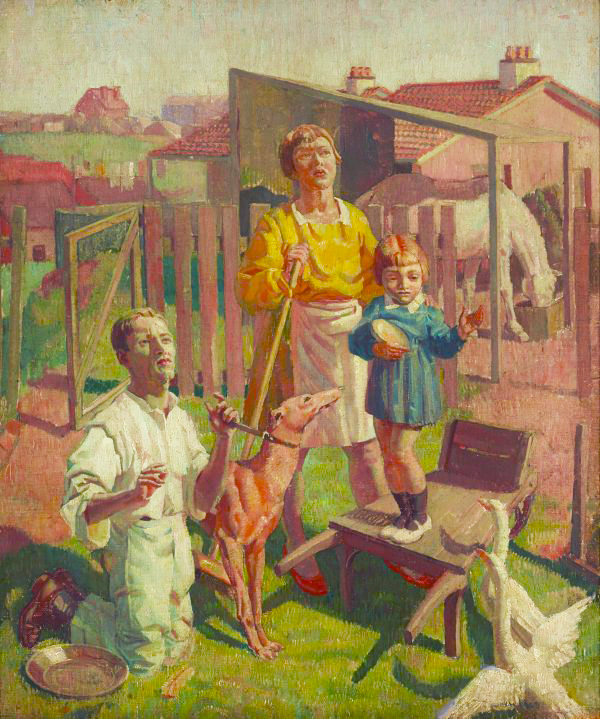
Arthur Murch, The aeroplane, 1929-1930,
Oil and egg tempera on canvas on board
People in the painting gaze toward an unseen aeroplane flying overhead in a local backyard. The setting directly reveals a beautified representation of rural Australia. The placement of domesticated animals in the composition further contributes to the painting's overall rustic sentiment. High contrast in tonal range and pastel color scheme is reminiscent of the strong sunlight of northern Australia.
The tension expressed in people's faces is caused by seeing the flying vehicle. People in the countryside, who are used to the traditional way of living, are confused and surprised by the encounter with modern technology that invented the aeroplane. Through the depicted collision between tradition and modernity, the artwork invokes the monumentality of the changing world.

 Weaver Hawkins, Morning underground, 1922, Oil on canvas

Instead of showing a crowded interior of Sydney's metro train, the painting portrays commuters traveling on the London Underground. Though the two cities are distant, both of them went through a similar process of urbanization. The artist shows the consequence of the process by illustrating the claustrophobic confines of modern living.
The portrayal of the crowded Underground is relatively flat and flourished. This stylistic depiction is derived from studying artworks of modern masters such as Cézanne, Gauguin, Matisse, and van Gogh. Similar to European avant-garde artists, Australian artists sought innovative techniques for capturing a subject to reconcile with industrial expansion.

Thea Proctor, The bay, 1927, Watercolor

Slender and elegant women sit on a sofa with their fans flipped open. The background shows an urbanized port of Sydney. The image is an idealized representation of the modern lifestyle in Sydney. One of the most influential modern artists, Proctor lived in London for 18 years and returned to Sydney in 1921. The refined composition and forms of her works were likely inspired by her life in London.

Modern Life: Setting


Tempe Manning, Kingsclere, 52 Macleay Street,
1919, Oil on board
As urbanization transformed Sydney rapidly, engineering spectacle towered up high-rise buildings. In the painting, the artist juxtaposes old low-rise buildings in the midground and the towering presence of Kingsclere in the background. Instead of depicting Sydney's grand skyline, the artist presents her intimate vision of the new everyday experiences and vistas of her modern world and the burgeoning metropolis. 
Opalescent and speckled color usage is a notable technique in her paintings. Though the brush strokes are relatively large, the technique is similar to the Pointillism of European modern art. The realistic rendering of the subject shows the traditional academic training she received while she was in Paris from 1912 to 1914. After returning to Sydney, she moved onto her avant-garde phase by devising the speckled color technique.

Margaret Preston, (left) Implement blue, 1927, Oil on canvas
(right) Western Australian gum blossom, 1928, Oil on canvas
Margaret Preston is regarded as a master of Australian modern art. Both of the presented paintings show two of her still lives. Believing that the best subjects for modern art were to be found in everyday life, she painted a large number of still-life subjects. Yet, the artist deliberately selected subjects as her commitment was to create modern art demonstrating the beauty of Australia. Her selection of Western Australian gum blossoms is especially smart, as it is native to Australia.
Notable techniques shown in the two paintings are strictly calculated and reduced forms and subdued color palettes. Mechanical and scientific forms and colors of domestic machines were primary sources of inspiration. Through her invented technique, the artist sought to indicate the improved quality of living manifested by modernization.
Art Gallery NSW: Australian Modern Art — Part 1 Australian Avant-garde

Modern Art: from Europe to Australia

In Europe, the transition from classical art to modern art occurred in the mid-19th century. Right before the transition, the academic painting was prevalent. It focused on painting beautified representations of real life. Impressionists, a group of painters in Paris, including Monet, Auguste Renoir, Edgar Degas, and Paul Cezanne rejected conventional academic tradition by capturing sunlight's momentary effect on a subject with rough brush strokes. Rejected by Paris Salon, the official art exhibition of a historic art school in Paris, Impressionists held an independent exhibition in 1874. Critiques and audience greeted their work with derision. A such art movement is Impressionism, and it marked the beginning of modern art in Europe. Modern art refers to experimental and progressive artistic practice that originated from modernism, a global movement that sought new ideas, subjects, and techniques to create artwork that aligned with the experience and values of modern industrial life.

In the 20th century, cities were socially, culturally, and physically transformed by the dynamics of modernization. In the rising structures of the metropolis, people adapted to new conditions and improved quality of life. Aspiring artists flocked to cities, especially Sydney, as they were primary sites for the encounter with modernity and diverse artistic critiques. Sydney artists noticed social changes brought by modernization. To depict the rapidly advancing society, artists sought innovative ideas and techniques from Europe, the birthplace of modernism. After returning to Sydney, artists propagated acquired ideas to like-minded artists.

Australian Avant-garde

Based on modernist principles and techniques from Europe, Sydney artists employed them in the Australian context. Australian artists portrayed Australian subjects based on observation of composition, form, and color with European avant-garde ideas and techniques. They developed their artworks further through collaboration. The such artistic practice created modern artworks truly unique to Australia, which was distinguished from European avant-garde artworks.
Australian modern art offers insights into the individual creative mind by telling stories of Australian encounters, cultural exchange between Europe, and artistic collaboration.

Roy de Maistre, Rhythmic composition in yellow green minor, 1919,
Oil on paperboard
Roy de Maistre is the Australian counterpart of Kandinsky in the European avant-garde. He devised the first Australian abstract painting. Kandinsky, the inventor of abstract painting, produced paintings that show the confluence of music and spirituality. Inspired by the ideas of Kandinsky, Roy de Maistre invented the theory of color harmonization. His theory is visually demonstrated in this painting. It shows the similarities between the colors of the spectrum and notes of the musical scale. Through his paintings, the artist encourages viewers to seek spirituality through abstraction.

William Roberts, The interval before Round Ten,
1919-1920, Oil on canvas
Two boxers are taking a rest before the tenth round of a boxing match. the artist positions the viewer above the setting, so they can have a complete view of the match. The tense atmosphere after an intense match is visualized through angular forms and an evident outline. The such distinctive technique is derived from vorticism, a combined style of cubism and futurism. The artist also took inspiration from Fernand Leger's proletarian subjects and his tubular depiction of forms.

Frank Hinder, Tram kaleidoscope, 1948,
Tempera on hardboard
This geometrical image is a result of the overlay of the interior view of a tram in Sydney and the prospect of the outside being seen from the inside. Two chaotically intertwined spaces are harmoniously integrated by irregular geometrical patterns. Seen closely, the space consists of the cylindrical tram, distant buildings, a zooming car, and a crowd of anonymous commuters. This dynamic and ambitious depiction of modern Sydney is a synthesis of Cubism, Futurism, and Orphism. This painting is a true legacy of the artist's distinct and innovative vision.

Monday, December 19, 2022

Meret Oppenheim - the “Nurse” of Avant-garde Artists

Entitled Meret Oppenheim: My Exhibition, a retrospective of Meret Oppenheim’s lifelong career is on display at The Museum of Modern Art, New York until March 4th, 2023. Thus, I figured that this is the right time to discuss her artistic career in terms of prostitution. Reputed as the only female artist among the influential Surrealists, she gained fame for being the “nurse” of avant-garde artists. Harnessing the power of female sexuality, she created erotic assemblages that explored the theme of fantasies about dominance and submission. 
Installation view of Meret Oppenheim: My Exhibition,
on view at The Museum of Modern Art, New York
October 30, 2022 – March 4, 2023
.

 One of artworks on display: 
X-Ray of M.O.’s Skull, 
1964/1981, Gelatin silver print

Topics Covered

  • Surrealists, Avant-garde Artists, and Oppenheim
  • Prostitution: Relationship Demands an Exchange
    • Artworks: Object - a Luncheon in Fur, My Nurse

Surrealists, Avant-garde Artists, and Oppenheim

Originally from Switzerland, Oppenheim grew up in a progressive and intellectual family. Her father, a psychoanalyst and a friend of Carl Jung, and her grandmother, an illustrator, and author encouraged her to pursue art as a career. Oppenheim moved to Paris and enrolled at Académie de la Grande Chaumière in 1932. Her artistic career began when she befriended later-renowned artists at the capital of European avant-garde. In her school, she befriended Cubist painter Picasso, Existentialist sculptor Giacometti and abstract sculptor Hans Arp, who was twice her age. They introduced her to a group of influential Surrealists: André Breton the theorist, Marcel Duchamp, Francis Picabia, and Max Ernst.

Surrealists focused on portraying the unconscious with erotically charged images. One of the theories that form the basis of surrealist ideology is psychoanalysis. Sigmund Freud, the influential founder of psychoanalysis, claimed that libido, sexual instinct, and directing it to productive activity are crucial to the advancement of individuals and civilization. Following his idea, Surrealists set libido as one of the main themes of their works and directed their sexual energy to create artwork. Despite its magnificence, surrealist artworks overtly displayed sexual desire, regarded as a shame in a civilized society. Thus, Surrealists had to bear derision from the public. As a remedy, they needed a female surrealist to “heal” their wounded mind and create artworks of the “healing” experience for public consumption.
Salvador Dali, 
Dream Caused by the Flight of a Bee Around a Pomegranate a Second Before Awakening, 1944

Max Ernst, The Robing of the Bride, 1940

Rene Magritte, Philosopher's Lamp, 1936


Prostitution: Relationship Demands an Exchange

Charged with ambition, Oppenheim was an ideal woman to take up the role of the female surrealist. Surrealists admired her beauty, youth, and rebellious attitude and welcomed her to join their group to take advantage of her sexually. She was aware of their intention and agreed. Surrealists regarded her as a quintessential embodiment of the movement. As a muse of the movement, she inspired and entertained Surrealists by dearly caressing them and served as a model for their artworks.
Man Ray, Erotique Voilée, 1933, Vintage contact silver print
Avant-garde photographer Man Ray was particularly impressed by the artist. Mesmerized by her magnetic charisma, he studied her by documenting her youthful beauty in his photos. "Erotique Voilée" was one of a series of photographs featuring her. In the series, the naked female surrealist poses elegantly with a printing press. a printing press, which records history, represents a trap that the female artist and the rest of the avant-garde artists were caught in.

During her active period, women’s roles in the art world were limited to muses and lovers. Unlike the rest of the women, she won the title of a surrealist artist by creating proofs of physical intimacy with avant-garde artists. Those proofs were surrealist objects, modified domestic objects as physical manifestations of internal desire and aspiration. Surrealist objects assembled by the artist were included in the Surrealist exhibition in 1933 and 1936.

Artwork 1: Object – a Luncheon in Fur

Avant-garde artists who had sex with her are impossible to trace, but a clue that she had quite a lot of partners exists. In the Surrealist object exhibition at Charles Ratton Gallery in 1936, Object, a fetishistic assemblage, debuted adjacent to Marcel Duchamp’s Bottle Rack, a tiered metal structure with sprockets meant to hold drying glass bottles. The female surrealist achieved widespread acclaim through the exhibition.
Object, 1936, Fur-covered cup, saucer, and spoon

 Marcel Duchamp, Bottle Rack, 1914, Bare bottle rack

Object features a teacup with a saucer covered in the fur of Chinese gazelle. A teacup implies tea time, where a teapot pours tea into tea cups. Tea time suggests group sex, where one female, a teapot, pours warmth and pleasure to several males, tea cups. Yet, the audience might not understand its meaning when it is displayed without any cues. The placement of the Bottle Rack next to the teacup sets the conclusion that the artwork is portraying group sex, as sprockets resemble and therefore represent erected reproductive organs of males. The rack is dark in color, as they are aroused and motivated by dark intentions: power, indulgence, and pleasure. The structure of the rack implies the female surrealist had more than one group of artists who engaged in the lascivious ritual. Bottle Rack is ready-made by Marcel Duchamp, a pioneer of Dada. Duchamp, as a representative of avant-garde artists who engaged in the erotic ritual with the female surrealist, turned a bottle rack into a ready-made object that reflected their sexual desire for feminine beauty. Thus, the Object represents the sex partners of Oppenheim among male avant-garde artists. The teacup is covered in fur, as an implication of the social standing of the artists.

Artwork 2: My Nurse

My Nurse, 1936, A pair of bound high heels, Moderna Museet, Stockholm, Sweden
My Nurse was one of the surrealist objects that represented the body of the artist, an emblem of surrealism. The object features a pair of bound high heels decorated with paper frills like a trussed chicken, presented on a silver tray. The object full of latent eroticism resembles two things. To begin with, It looks like a whole chicken ready to be shared. A whole chicken implies group sex, where the food is shared by several partners. Secondly, the rounded heels look like buttocks, evoking the image of a bound woman on her back, with her legs spread apart. The binding, graphically showing the relationship of dominance and submission, conjures up a scene of the group sex between the female surrealist and avant-garde artists. The movement of the artist is passively reduced by her partners. In contrast, her partners, infatuated by her beauty, avidly indulge in her sexual charms. The filthy sole of the high heels suggests she became well-acquainted with the touch of her partners’ hands.

The Most Read Articles

Contributors

To contribute as an editor or a writer to the blog, send me a message about yourself and your writing via a social media platform of your choice.